A drone is a male honey bee. Similarly, A male deer is called stag.
Hence Deer is correct answer.Question Discussion & Solution
forum Community Discussion
No discussions yet. Be the first to start!
You must be logged in to participate in the discussion.
login Login to Discussauto_awesome Similar Questions
Answer: Option 3
Concept:
Tree:
- A tree consists of nodes or vertices that store information and often are labeled by a number or a letter.
- A tree consists of directed edges or undirected edges or both.
- The number of subtrees of a node is called its degree.
- A leaf or a terminal node is a node of degree zero
- A node that is not a leaf is called an interior node or an internal node
- The degree of a node is the number of its children. The degree of a tree is the maximum degree of any of its nodes.
Ancestors of a node in a Tree:
The ancestor nodes of a node are all parent nodes of that particular node.
Explanation:
Consider the following Binary Tree
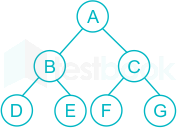
Every node except the root node (A) has ancestors.
Hence in a tree, the only node that has no ancestors is the root node. (only one node possible)

Additional Information
Full Binary Tree:
A full binary tree is a binary tree in which each node has exactly two or 0 children.
Complete Binary Tree:
A complete binary tree is a binary tree in which
- except last level tree is completely filled.
- The last level is filled from left to right.
Perfect Binary Tree:
A perfect binary tree is a binary tree in which
- all interior node or internal nodes has 2 children.
- all leaves are at the same level.
Balanced Binary Tree:
A Balanced Binary tree is a binary tree in which at any node height of the left subtree and right subtree do not differ by more than 1.

Important Points
1. A tree with n nodes has n - 1 edge.
2. consider a nonempty binary tree with n0 leaves and n2 nodes of degree two (internal nodes). Then
n0 = n2 + 1
Applications of Trees:
1. Huffman Coding
2. Evaluation of Arithmetic Expressions using Expression trees
The correct answer is Femur.
Key Points
- The largest bone in the human body is the femur, the thighbone.
- It is the largest, longest, and strongest bone in the human body.
- The femur runs from the keen to the hip.
- The Femur or thigh bone is the largest and heaviest bone in the human body.
- At the proximal end of the Femur, there is a rounded prominence which is called the Head of the Femur.
- The femur runs from the keen to the hip.
- It carries all the upper body weight.
- The other parts of the leg are the tibia, femur, fibula, and keep cap also known as patella.
Additional Information
- The human skeleton is made up of 206 bones, including bones of the
- Skull: including the jaw bone (mandible, maxilla)
- Spine: cervical, thoracic and lumbar vertebrae, sacrum and tailbone (coccyx)
- Chest: ribs and breastbone (sternum)
- Arms: the shoulder blade (scapula), collar bone (clavicle), radius, humerus and ulna
- Hands: wrist bones (carpals), metacarpals and phalanges
- Pelvis: hip bones
- Legs: the thigh bone (femur), the kneecap (patella), shin bone (tibia) and fibula
- Feet: tarsals, metatarsals, and phalanges.
Which of the following minerals is not found in the Chhota Nagpur Plateau?
The correct answer is Gold.
- Gold is not found in the Chota Nagpur Plateau.
Key Points
- Chhota Nagpur Plateau:
- Chotanagpur plateau represents the north-eastern projection of the Indian Peninsula.
- Chhota Nagpur plateau has an abundance of mineral resources such as mica, bauxite, copper, limestone, iron ore and coal.
Additional Information
- Gold in India is found in Karnataka and Uttar Pradesh.
1024 bytes = 1 kilobyte.
1024 kilobytes = 1 Megabyte.
1024 megabytes = 1 Gigabyte.
1024 gigabytes = 1 Terabyte.
Hence, amongst the given, KB is the smallest unit of storage.The Correct Answer is "Cache Memory".
Important Points
Cache Memory :
- Cache Memory is a special very high-speed memory.
- It is used to speed up and synchronizing with a high-speed CPU. Cache memory is costlier than main memory or disk memory but economical than CPU registers.
- Cache memory is an extremely fast memory type that acts as a buffer between RAM and the CPU.
- It holds frequently requested data and instructions so that they are immediately available to the CPU when needed.
- Cache memory is used to reduce the average time to access data from the Main memory.
Additional Information
Secondary Memory :
- It is non-volatile, i.e. it retains data when power is switched off.
- It is large capacities to the tune of terabytes.
- It is cheaper as compared to the primary memory.
- Depending on whether the Secondary memory device is part of the CPU or not, there are two types of secondary memory – fixed and removable.

Auxiliary Memory :
- Auxiliary memory is the non-volatile memory lowest-cost, highest-capacity, and slowest-access storage in a computer system.
- It is where programs and data kept for long-term storage or when not in immediate use.
- Such memories tend to occur in two types-sequential access (data must access in a linear sequence) and direct access (data may access in any sequence).
- The most common sequential storage device is the hard disk drives, whereas direct-access devices include rotating drums, disks, CD-ROMs, and DVD-ROMs.
- It used as permanent storage of data in mainframes and supercomputers.
Virtual Memo :
- A computer can address more memory than the amount physically installed on the system.
- This extra memory is actually called virtual memory and it is a section of a hard disk that's set up to emulate the computer's RAM.
- The main visible advantage of this scheme is that programs can be larger than physical memory.
- Virtual memory serves two purposes.
- First, it allows us to extend the use of physical memory by using the disk.
- Second, it allows us to have memory protection because each virtual address is translated to a physical address.