- IPC Section 376 A Whoever commits an offense rape(under section 376) and in the course of such commission inflicts an injury which causes the death of the woman or causes the woman to be in a persistent vegetative state.
-
Law/Act Description IPC Section 376 - Whoever commits rape, shall be punished with rigorous imprisonment of either description for a term which shall not be less than ten years, but which may extend to imprisonment for life, and shall also be liable to fine.
- Whoever being a police officer, public servant, member of the armed forces, the management or on the staff of a jail, the management or on the staff of a hospital, being a relative, guardian or teacher of, or a person in a position of trust or authority towards the woman, commits rape shall be punished with rigorous imprisonment for a term which shall not be less than ten years, but which may extend to imprisonment for life, which shall mean imprisonment for the remainder of that person’s natural life, and shall also be liable to fine.
- Whoever commits rape on a woman under sixteen years of age shall be punished with rigorous imprisonment for a term which shall not be less than twenty years, but which may extend to imprisonment for life, which shall mean imprisonment for the remainder of that person’s natural life, and shall also be liable to fine
IPC Section 376 A - Whoever commits an offense punishable under sub-section (1) or sub-section (2) of section 376 and in the course of such commission inflicts an injury which causes the death of the woman or causes the woman to be in a persistent vegetative state, shall be punished with rigorous imprisonment for a term which shall not be less than twenty years, but which may extend to imprisonment for life, which shall mean imprisonment for the remainder of that person’s natural life, or with death.
IPC Section 376 B - Whoever has sexual intercourse with his own wife, who is living separately, whether under a decree of separation or otherwise, without her consent, shall be punished with imprisonment of either description for a term which shall not be less than two years but which may extend to seven years, and shall also be liable to fine.
IPC Section 376 C -
Whoever is in a position of authority or in a fiduciary relationship; or a public servant; or superintendent or manager of a jail, remand home or another place of custody established by or under any law for the time being in force, or a women’s or children’s institution; or
on the management of a hospital or being on the staff of a hospital, abuses such position or fiduciary relationship to induce or seduce any woman either in his custody or under his charge or present in the premises to have sexual intercourse with him, such sexual intercourse not amounting to the offence of rape, shall be punished with rigorous imprisonment of either description for a term which shall not be less than 5 years, but which may extend to ten years, and shall also be liable to fine.
IPC Section 376 D - Where a woman is raped by one or more persons constituting a group or acting in furtherance of a common intention, each of those persons1 shall be deemed to have committed the offence of rape and shall be punished with rigorous imprisonment for a term which shall not be less than twenty years, but which may extend to life which shall mean imprisonment for the remainder of that person’s natural life, and with fine
IPC Section 376 E - Whoever has been previously convicted of an offense punishable under section 376 or section 376A or section1 376AB or section 376D or section 376DA or section 376DB and is subsequently convicted of an offense punishable under any of the said sections shall be punished with imprisonment for life which shall mean imprisonment for the remainder of that person’s natural life, or with death.
Question Discussion & Solution
forum Community Discussion
No discussions yet. Be the first to start!
You must be logged in to participate in the discussion.
login Login to Discussauto_awesome Similar Questions
If the mirror is placed to the right of the figure, what will be the correct mirror image of the given figure?

The mirror image are given bellow

Hence, option 2 is the correct answer.
Select the number from among the given options that can replace the question mark (?) in the following series.
7, 9, 14, 24, ?, 67
The pattern followed here is:

Hence, '41' is the correct answer.
The correct answer is Fructose.
 Key Points
- Fructose
- It is naturally occurring sugar.
- It is the sweetest sugar.
- It is a 'monosaccharide', meaning the simplest form of sugar, which means it cannot be broken down into more basic sugar units.
- Other common examples of monosaccharides are glucose and galactose.
- The chemical formula of fructose is C6H12O6.
 Additional Information
- Maltose
- It is also a sweet sugar which is also known as maltitol sugar.
- It is mostly found in honey.
- Its molecular formula is C12H22O11.
- Glucose
- It is the most abundant monosaccharide, a carbohydrate sub-category.
- During photosynthesis, glucose is primarily produced by plants and most algae from water and carbon dioxide, using energy from sunlight, where it is used to create the most abundant carbohydrate cellulose in cell walls.
- The chemical formula of glucose is C6H12O6.
- Sucrose
- It is crystallized white sugar produced by the sugar cane plant and can be found in households and foods worldwide.
- The formulae for sucrose is C12H22O11.
- It is a disaccharide so when we hydrolyse it we will get one molecule of glucose and another molecule of fructose.
- It is also known as table sugar.
- The formulae for sucrose is C12H22O11.
Concept:
- The laws dealing with ideal gases naturally called ideal gas laws, and the laws determined in the seventeenth century by Boyle's observational work and in the eighteenth century by Charles.
- The Boyles Law states that the gas pressure is inversely proportional to the gas volume for a given mass of gas stored at a constant temperature.
- Charles Law states that the gas volume is directly proportional to the gas temperature for a given fixed mass of gas stored at a constant pressure.
- An ideal gas is a gas that follows the equation:
PV = nRT at all temperatures and pressure, where P = Pressure of the ideal gas. V = Volume of the ideal gas n = Amount of ideal gas measured in terms of moles
R = Universal gas constant T = Temperature
Mole Concept -
- The quantity one mole of a substance signifies 6.022 × 10²³ number of particles of that substance which may be atoms, molecules, or ions.
- The quantity is a universal constant like Dozen, Gross, etc., and is known as Avogadro number, denoted by NA. after the scientist Amedeo Avogadro.
- Examples- In one mole of H2, there are 6.022 × 10²³ molecules of hydrogen, and the number of atoms is 2 × 6.022 × 1023, as one molecule of hydrogen contains two-atom each.
- The mass of one mole of a substance is called its Molar Mass (M) or Atomic mass expressed in grams.
- The volume occupied by a mole of gas is 22.4 L at NTP, called its Molar Volume.
- The no. of moles (n) is calculated as =
The number of particles / Avogadro’s number.
To summarise, we can say,
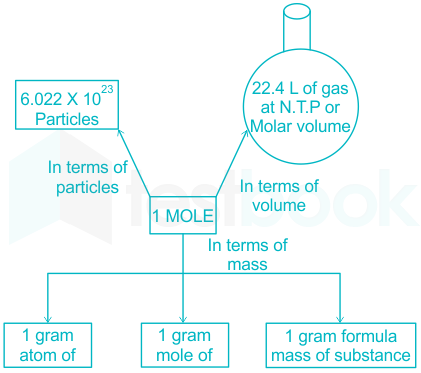
Calculation:
- The molar mass of 1 mole of H2SO4 is =
2 × 1 + 32 + 4 × 16 = 98g
- The molar mass of 1 mole of Silver, Ag is its molecular mass 108g.
- The molar mass of CO2 is = 12 + 2× 16 = 44g.
- 44g of CO2 means one mole.
- 1 mole of Oxygen weighs 16 + 16 = 32g.
- Hence, the highest mass is of 1 mole of Ag.
Windows 95 is an example of which type of operating system?
The correct answer is Single-User Operating System.
 Important Points
- Single-User Operating System
- Performs a single task for Single-user.
- This operating system is designed to manage the computer so that one user can effectively do one thing at a time.
- Examples include Microsoft Windows.
Additional Information
- The different types of Operating System:
- Batch Operating System
- There is no direct communication between the computer and the OS.
- There is an intermediate, the Operator.
- The operator distributes the work into batches.
- Real-Time Operating System
- The processing time is very small between the user’s command and the output such that there is no operator.
- Time-Sharing Operating System
- Multiple people at various computers can use a program at the same time.
- Distributed Operating System
- When two or more systems are connected to each other and one can open each other's files.
- Embedded Operating System
- These special Operating systems are built into larger systems.
- They are limited to single specific functions like an ATM.
- Network Operating System
- They have one main server which is connected to other client servers.
- It provides a secure operating system for working with multiple users.