Question Discussion & Solution
NAT
Q.
What is the square root of 144?
Correct Answer: 12
12 * 12 = 144.
forum Community Discussion
speaker_notes_off
No discussions yet. Be the first to start!
sync
Loading more...
You must be logged in to participate in the discussion.
login Login to Discussauto_awesome Similar Questions
MCQ
1.
Who wrote Kitab-ul-Hind?
Correct Answer: B
The correct answer is Al-Biruni.
Key Points
- Abu Rayhan al-Biruni was an Iranian scholar.
- He has been variously called as the:-
- Founder of Indology
- Father of Comparative Religion
- Father of modern geodesy
- The first anthropologist
- He wrote the book Kitab-ul-Hind.
- Alberuni (Abu Raynham Beruni) was a Persian scholar who came to India with Mahmud of Ghazni in 1017.
- He commented on Indian sciences, Hindu religious beliefs, customs, and social organization.
Additional Information
- Al-Masudi's Book - The Meadows of Gold
- Sulaiman's Book - Ancient Accounts of India and China
- Firdausi's Book - Shahnameh
MCQ
2.
Ajanta and Ellora caves are located in ________.
Correct Answer: B
The correct answer is Maharashtra.
- Ajanta is 100 kilometres from the Ellora Caves, which contain Hindu, Jain and Buddhist caves, the last dating from a period similar to Ajanta.
- Ellora is a UNESCO World Heritage Site located in the Aurangabad district of Maharashtra, India.
Key Points
- These Buddhist and Jain caves are ornately carved, yet seem quiet and meditative and exude divine energy and power.
- These are the rock-cut caves of Ajanta nestled in a panoramic gorge, in the form of a gigantic horseshoe.
Additional Information
- Ajanta Caves constitute ancient monasteries and worship-halls of different Buddhist traditions carved into a 75-meter (246 ft) wall of rock.
- The caves also present paintings depicting the past lives and rebirths of the Buddha, pictorial tales from Aryasura's Jatakamala, and rock-cut sculptures of Buddhist deities.
- The caves, cut into the face of a mountain, form a horseshoe shape around the Wangorah River.
- They are an example of one of Indian's unique artistic traditions known as rock-cut temples. Ajanta consists of thirty caves, each dedicated to the life of the Buddha.
- Ellora (also known as Elura and, in ancient times, as Elapura) is a sacred site in Maharastra, central India.
- The Ellora Caves are listed by UNESCO as a World Heritage Site and are celebrated for their Hindu, Buddhist, and Jain temples and monuments which were carved from the local cliff rock in the 6th to 8th century CE.
- Ellora Caves served as lodgings to the travelling Buddhist and Jain monks besides being a site for the trade route.
- A part of the Hindu and Buddhist Caves were built during the Rashtrakuta dynasty, and the Jain Caves were built by the Yadav dynasty.
MCQ
3.
Patanjali is well known for the compilation of
Correct Answer: A
The correct answer is Yoga sutra.
- Yoga Sutra of Patanjali is a collection of 195 Sanskrit sutras (aphorisms) on the theory and practice of yoga.
- Yoga Sutra was compiled sometime between 500 BCE and 400 CE by the sage Patanjali in India who synthesized and organized knowledge about yoga from much older traditions.
Additional Information
- Panchatantra, by Vishnu Sharma, is an ancient Indian collection of interrelated animal fables in Sanskrit verse and prose, arranged within a frame story.
- Brahma Sutras
- It is a Sanskrit text, attributed to the sage Badarayana or sage Vyasa, estimated to have been completed in its surviving form in 400-450 CE, while the original version might be ancient and composed between 500 BCE and 200 BCE.
- Ayurveda
- It is considered by many scholars to be the oldest healing science.
- In Sanskrit, Ayurveda means “The Science of Life.”
- Ayurvedic knowledge originated in India more than 5,000 years ago and is often called the “Mother of All Healing.”
- It stems from the ancient Vedic culture and was taught for many thousands of years in an oral tradition from accomplished masters to their disciples. Some of this knowledge was set to print a few thousand years ago, but much of it is inaccessible.
MCQ
4.
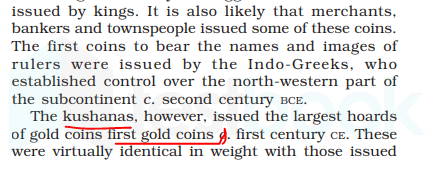
Who were the first kings to issue the largest hoards of gold coins in India?
Correct Answer: D
The correct answer is Kushans.
- Kushans were the first kings to issue the largest hoards of gold coins in India.

Key Points
- Kushanas Coins:
- Kushanas issued mostly gold coins and numerous copper coins which have been found in most parts of North India up to Bihar.
- The Gold Dinara's or Suvarnas were based on the Roman denarius and were of 124 grains (8.04 grams).
- Double and quarter Dinaras were also issued. The copper coins were large, from 26 to 28 Masas or 240 to 260 grains (15.55 to 16.85) grams.
- The coins of Vima Kadphises bear the figure of Siva standing beside a bull.
- In the legend on these coins, the king calls himself Maheshwara, i.e. devotee of Siva.
- Kanishka, Huvishka and Vasudeva etc. all have this depiction on their coins.
- Many Indian gods and goddesses are depicted on Kushana coins besides many Persian and Greek deities.

Additional Information
- Indo-Greek Coins:
- The Indo-Greek coins show beautiful artistic features them.
- The portrait or bust of the king on the obverse side appears to be real portraits. On the reverse, some deity is depicted.
- We know that more than forty Indo-Greek rulers ruled in a small north-western region of India from these coins.
- Pre Guptan and Guptan Coins:
- Gupta kings issued the most number of Gold coins.
- The Satavahanas issued coins of lead and potin (base silver).
- Satavahanas’ copper coins with the Ujjain symbol bearing a ship were abundant in Avanti.
- The gold coins of the Guptas (Dinara) originally approximated to the Kushana standard, but in the middle of the 5th century rose in weight to 144 grains, thus returning to the Indian standard of the copper Karsapana.

Mistake Points
- Gupta kings issued the most number of Gold coins whereas Kushans were the first kings to issue the largest hoards of gold coins in India.
Solution Source - https://ncert.nic.in/textbook/pdf/lehs102.pdf (Pg No. 44)
MCQ
5.
Who was the founder of Pala Dynasty?
Correct Answer: C
The correct answer is Gopala.
- Pala Dynasty:
- Its founder, Gopala, was a local chieftain who rose to power in the mid-8th century during a period of anarchy.
- His successor, Dharmapala, greatly expanded the kingdom and for a while was in control of Kannauj.
Additional Information
- The incredible Buddhist complex of Paharpur was created under the Pala dynasty in Bengal and fostered by successive leaders.
- The Pala dynasty ruled the regions of Bengal and Bihar for about 400 years, from the 8th century until the end of the 11th century, with about 20 leaders on the throne during the period.
- To begin to understand the Pala Dynasty, it's useful to look at the state of affairs when the first ruler took power.
- The region that is now north-eastern India and Bangladesh had been in a state of anarchy for about a century following the fall of the Post Gupta dynasty. Feudal lords had found themselves in a cycle of a petty conflict with no obvious path to resolution.
- It wasn't until one feudal lord named Gopala managed to gain the support of other leaders that stability started to emerge.
- Through a democratic process, he took control of the region called Varendra, made up of north-western Bangladesh, West Bengal, and the Indian area of Bihar. He would be the founder and first ruler of the Pala Empire.
- It was the dynasty's second ruler, the son of Gopala, who would have the biggest impact, though.
- His name was King Dharma Pala Deva (also known as Dharmapala) and he greatly expanded the territory of the empire, spreading across northern India. He is regarded as an efficient administrator and, during this period, the region flourished economically
category More Rajasthan G.K. Topics
article
Physical Characteristics
format_list_bulleted
1 MCQs
article
General Knowledge
format_list_bulleted
1 MCQs
article
General
format_list_bulleted
99 MCQs
article
Art and Culture of Rajasthan
format_list_bulleted
90 MCQs
article
Rajasthan Geography
format_list_bulleted
139 MCQs
article
Current Affairs 2022
format_list_bulleted
75 MCQs
article
Ancient History
format_list_bulleted
15 MCQs
article
Medieval History
format_list_bulleted
15 MCQs
article
Modern History
format_list_bulleted
25 MCQs
article
History
format_list_bulleted
83 MCQs
article
Geography
format_list_bulleted
70 MCQs
article
Polity
format_list_bulleted
30 MCQs
article
Economy
format_list_bulleted
15 MCQs
article
Current 2021
format_list_bulleted
1 MCQs
article
Current 2022
format_list_bulleted
1 MCQs
article
Current 2023
format_list_bulleted
1 MCQs
article
Current 2024
format_list_bulleted
1 MCQs
article
Current 2025
format_list_bulleted
1 MCQs
article
Current 2026
format_list_bulleted
1 MCQs
article
Current 2027
format_list_bulleted
1 MCQs
article
Current 2028
format_list_bulleted
1 MCQs
article
Current 2029
format_list_bulleted
1 MCQs
article
Current 2030
format_list_bulleted
1 MCQs