MCQ
Q.
Which of the following is known as nearsigntedness?
Correct Answer: C
The correct answer is Myopia.
 Key Points
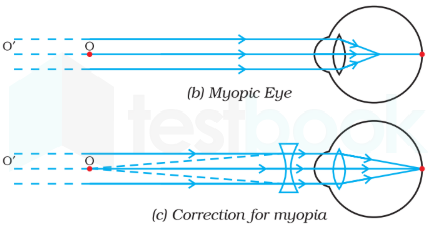
- Nearsightedness (myopia) is a common vision condition in which you can see objects near to you clearly, but objects farther away are blurry.
- It occurs when the shape of your eye causes light rays to bend (refract) incorrectly, focusing images in front of your retina instead of on your retina.
- A Concave lens (diverging lens) is used by people suffering from myopia.
 Additional Information
- Far-sightedness, also known as long-sightedness, hypermetropia, or hyperopia, is a condition of the eye where distant objects are seen clearly but near objects appear blurred.
- This blurred effect is due to incoming light being focused behind, instead of on, the retina wall due to insufficient accommodation by the lens.
- Night blindness is a type of vision impairment also known as nyctalopia.
- People with night blindness experience poor vision at night or in dimly lit environments.
- Although the term “night blindness” implies that you can't see at night, this isn't the case.
- Astigmatism: This defect arises due to the difference in the radius of curvature of the cornea in the different planes
- The cylindrical lens is used by people suffering from Astigmatism.
