
All are mammal except Lizard.
Hence, Lizard is the odd among them.Question Discussion & Solution
forum Community Discussion
No discussions yet. Be the first to start!
You must be logged in to participate in the discussion.
login Login to Discussauto_awesome Similar Questions
The correct answer is 2 ms-2

- We know that according to Newton's 2nd law,
- Force = Mass × Acceleration
- or \((\vec F = m \times \vec a)\)
- Here, F = 100 N and Mass = 50 Kg
- So, 100 = 50x a ⇒ a = 100/50 = 2.
- Hence, the acceleration will be 2 ms-2.
- Force: A force is something that changes the state of rest or motion of a body.
- It causes the body to start moving if it is at rest or stops if it is in motion or deflects from the initial path.
- Force is a vector quantity having SI unit Newton (N) and dimension (MLT-2).
- According to Newton’s Second law of motion
- The rate of change of momentum of a body is directly proportional to the resulting force acting on a body
- Mathematically it can be expressed as
- \(\vec F \propto \frac{{d\vec p}}{{dt}}\;or\;\vec F = m \times a\)
Concept:
- Potential Energy: The energy of an object obtained by doing work against the conservative forces like spring force and gravitational force is called potential energy.
- The Gravitational potential energy of an object at a height h from the ground is given as
P = mgh
The spring potential energy of spring when it is stretched x distance from its natural length is given as
\(P = \frac{1}{2}kx^2\)
- Kinetic Energy: The energy obtained by an object by virtue of its motion is called kinetic energy.
\(K = \frac{1}{2}mv^2\)
K is kinetic energy, v is the speed of the object, m is the mass of the object.
- Mechanical Energy: The sum of potential energy and kinetic energy is called mechanical energy.
Explanation:
So, from the above concept, it is clear that total mechanical energy is the sum of potential energy and kinetic energy.
So, the answer is the Sum of Kinetic Energy and Potential Energy.
The correct answer is Register, Cache, RAM, Hard disk.
- Register
- RAM
- RAM is a hardware element where the data being currently used is stored.
- It is a volatile memory.
- Two types of RAM are
- Static RAM, or (SRAM) and
- Dynamic RAM, or (DRAM).
- Register
- A register holds instructions or data that the processor is working on or will be working on shortly.
- They form part of the processor and are capable of holding only one item at a time.
- Cache
- Cache memory is an area in the computer where codes and instructions are stored.
- Hard disk
- A hard disk drive is an electromechanical data storage device that stores and retrieves digital data using magnetic storage.
- There are four major storage levels on the computer:
- Internal –
- Processor registers and cache.
- Main –
- The system RAM and controller cards.
- On-line mass storage –
- Secondary storage.
- Off-line bulk storage –
- Tertiary and Off-line storage.
- Internal –
Explanation:
- Parenchyma, Sclerenchyma, and Collenchyma are the Simple Permanent Plant tissues.
- Xylem and Phloem are the Complex Permanent Plant tissue.
- Sclerenchyma: supporting tissue in higher plants.
- Parenchyma: makes up most of the cells within leaves, flowers, and fruits.
- Collenchyma: provides support, structure, tensile strength, and flexibility which helps the plant to bend.
- Xylem:
- It is plant tissue that transports food water and other dissolved minerals from roots to other parts of the plant.
- Phloem:
- The main function of the phloem is to transport food materials from the leaf to other parts of the plant.
Consider the following array declaration in ‘C’ language:
int array[] = {2, 3, 4, 5};
What will be the output of the following statement?
printf("%d", 2[array]);
Key Points
An array is defined as the collection of similar types of data items stored at contiguous memory locations. Arrays are the derived data type in C programming language which can store the primitive type of data such as int, char, double, float, etc. C array is beneficial if you have to store similar elements.
int array[] = {2, 3, 4, 5}; This array storage be like,
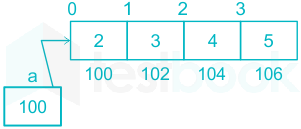
The above array at index I can be accessed by, a[i], i[a], *(a+i) or *(i+a) all the above representations all are equal and gives the i th index value.
printf(%d', 2[array]); So, it gives the 2nd index value. i.e 4.
Hence the correct answer is 4.

Additional InformationProgram:
#include
int main()
{
int arr[] = { 2, 3, 4, 5 };
printf("%d ",arr[2]);
printf("%d ",2[arr]);
printf("%d ",*(2+arr));
printf("%d ",*(arr+2));
return 0;
}
Output: 4 4 4 4
So above given 2nd index value is 4 for all above print statements.